
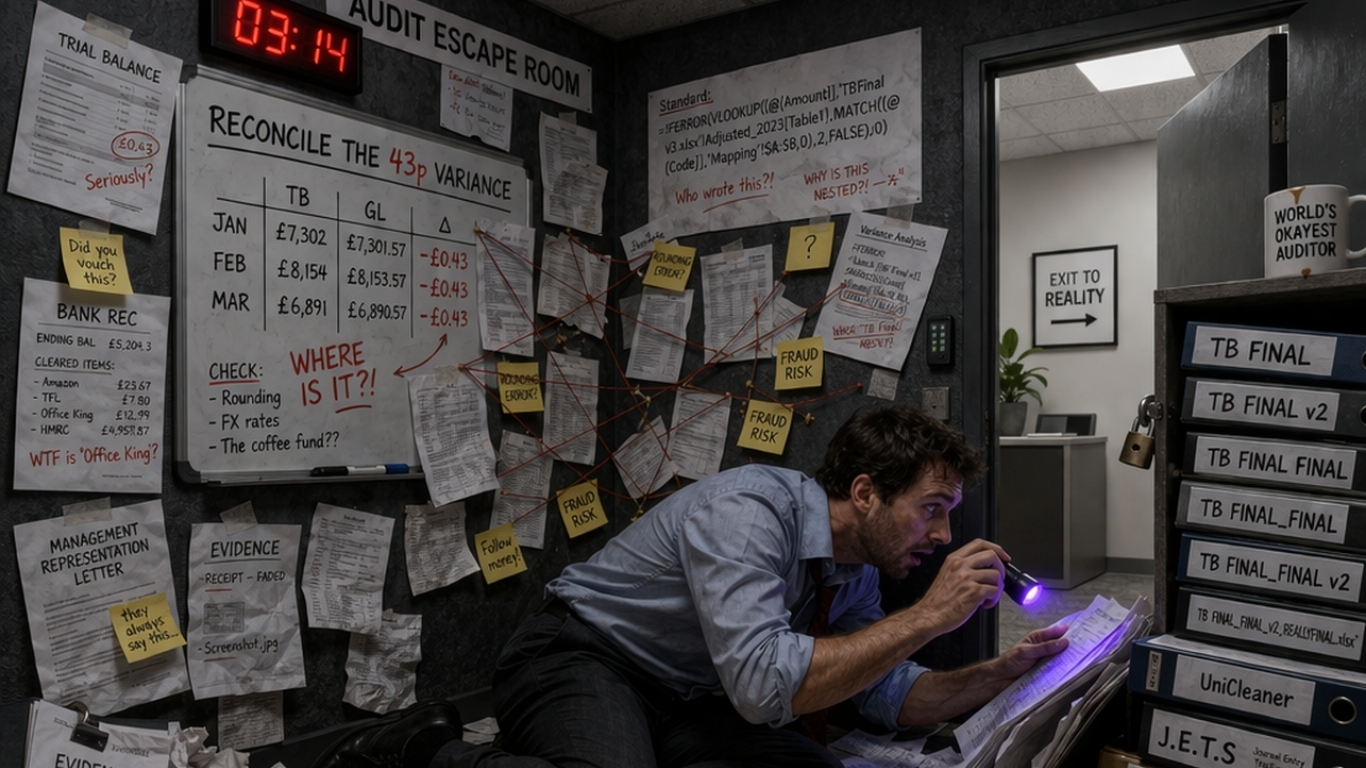
The air tastes like aggressively cheap fog machine juice and dust.
You are on your hands and knees in the dark, frantically shining a miniature purple flashlight onto a fake Persian rug. Across the room, your friend is aggressively shaking a plastic skull, yelling something about a Fibonacci sequence hidden in a portrait of a sad Victorian child.
The digital clock on the wall flashes 03:14 in bright red. Three minutes left.
You are sweating. Your heart is hammering against your ribs. You are desperately trying to decode a cipher written in invisible ink, just so you can unlock a wooden box, which contains... another, slightly smaller key.
Here is the absurd part: You paid for this.
You willingly handed over your own money on a perfectly good Saturday afternoon to be locked in a windowless room and subjected to entirely artificial stress.
The labyrinth was designed backwards. The danger is an illusion. The complexity was manufactured strictly to make you feel like you are doing something intensely difficult, and therefore, deeply important. When the buzzer finally sounds and the door pops open, you walk out into the lobby, exhausted but relieved, vowing never to put your nervous system through that again.
Then, Friday afternoon rolls around.
It’s 4:30 PM. You are staring at a screen, running a nested, six-layer XLOOKUP that feels dangerously close to cutting the red wire on a bomb. You are cross-referencing a scrambled PDF against a sprawling 14-tab spreadsheet, hunting for a 10 pound variance hiding somewhere in 80,000 rows of raw data.
Only this time, there is no buzzer.
The exhaustion isn’t a game, and it isn't for entertainment. It is a quiet thief. It steals your evening, your energy, and your clarity.
Somewhere along the line, we started confusing difficulty with assurance. We convinced ourselves that if a file isn’t a painful, convoluted labyrinth of colour-coded tabs, hidden columns, and nine-page explanatory memos, we simply haven’t worked hard enough. We build massive digital escape rooms because it gives us the illusion of safety.
We pull “just in case” extracts. We reconcile the reconciliations. We write massive memos to explain why the client's system exports data in wingdings, instead of just structuring the data first.
Complexity isn’t a badge of honour. It is a trap you built for yourself.
When you strip the work back to its absolute foundation, something shifts. You don’t do less work. You do lethal work.
The truth about that spreadsheet keeping you late on a Friday? The client didn't lock you in. The partner didn't lock you in.
You did.
The padlock is on the inside. You don’t need a UV light, a fake skull, or a decoder ring. You just need to stop playing the game.
The door is right there. Will you walk out?
Until next time,
Christiaan
.png)







































































.png)
.png)
.png)


.png)
.png)
.png)







Help your team work faster in Microsoft Excel without
sacrificing control, traceability, or audit quality.
Inspiration not perspiration with tips and insights to audit smarter, straight to your inbox.
You can unsubscribe at any time. We respect your information and won’t share your data with any 3rd parties. Learn more about our privacy policy.

.svg)

.png)
