

You wake up.
Check your phone.
The world is already in motion.
Markets moving.
Political tension somewhere.
Another AI announcement that promises to change everything again.
Opinions. Predictions. Breaking news.
It’s a lot.
And then, quietly, the workday begins.
Because somewhere between global headlines and Teams notifications…you still need to open Excel and test revenue cut-off.
There’s something strangely philosophical about that moment.
The world feels unpredictable.
Headlines make everything sound urgent.
But work continues.
Ships still sail.
Planes still take off.
Companies still close their books.
And auditors still test the numbers.
Civilisation has always worked like this.
The world doesn’t pause until things feel calm again.
People simply keep doing the work that keeps everything moving.
But there’s a hidden challenge in the modern version of this.
We now experience all the noise, all the time.
Phones buzzing.
Messages arriving.
News cycling endlessly.
Attention gets pulled in a hundred directions before the day even properly starts.
And when attention is stretched thin, something subtle happens in audit work.
Everything starts to feel important.
Every fluctuation.
Every unusual number.
Every tab in the spreadsheet.
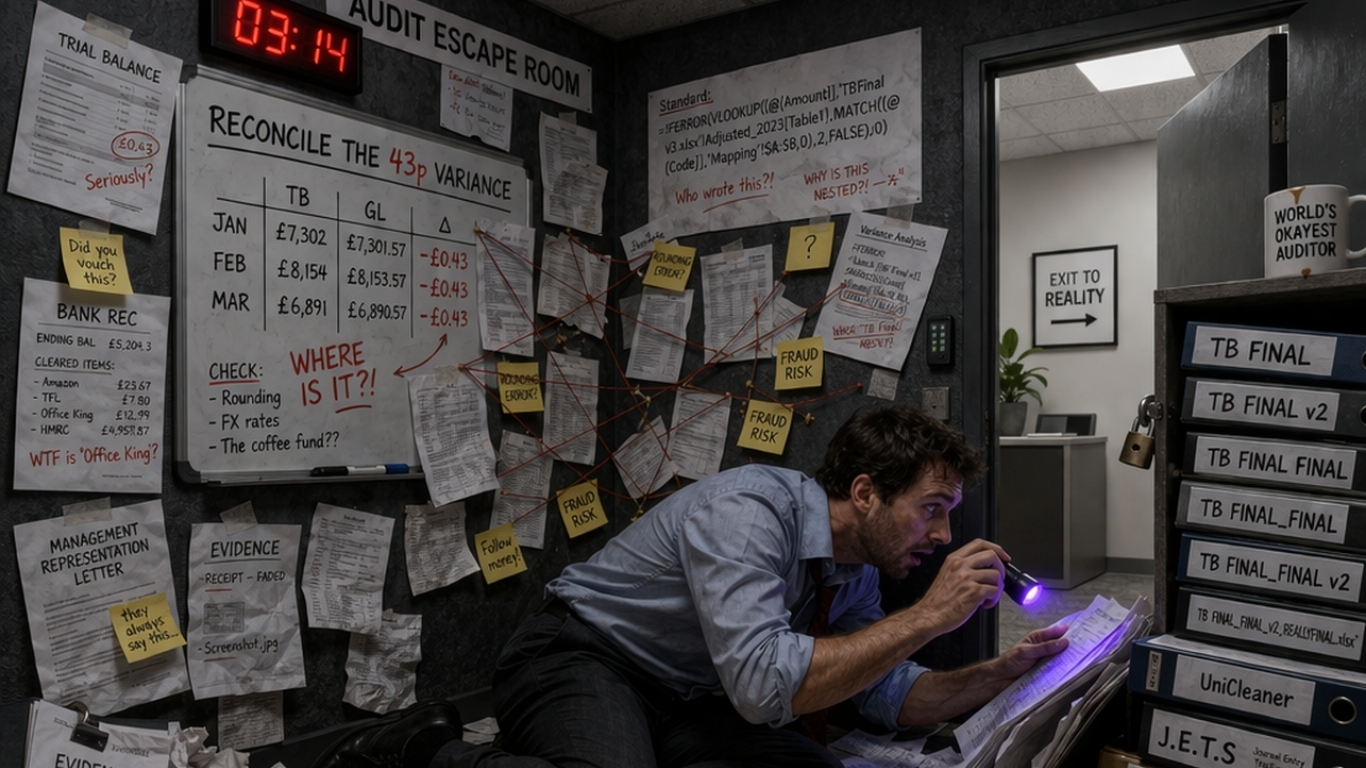
So we open everything.
Just in case something’s hiding.
But good auditing doesn’t come from looking everywhere.
It comes from knowing where not to look.
If the assertion is cut-off, the risk lives at the boundary.
If it’s fraud or significant risk, the signal usually sits inside unusual behaviour.
Patterns break somewhere specific.
Not everywhere.
When the world is loud, focus becomes a professional skill.
But here’s the quiet truth most people learn the hard way.
Busy season doesn’t reward spreading attention thinner.
It rewards sharpening it.
The internet will always buzz.
Notifications will always multiply.
Someone, somewhere, will always insist that everything matters.
But the work itself doesn’t work that way.
Good judgement rarely lives in the middle of the noise.
It lives at the edges.
So before opening the dataset, pause for a moment.
The same way you pause when the kettle clicks off.
The same way mornings sometimes force you to breathe before the day begins.
Name the assertion.
Then ask one simple question:
“If this went wrong, where would it actually happen?”
Until next time,
Christiaan
.png)































































.png)
.png)
.png)


.png)
.png)
.png)







Help your team work faster in Microsoft Excel without
sacrificing control, traceability, or audit quality.
Inspiration not perspiration with tips and insights to audit smarter, straight to your inbox.
You can unsubscribe at any time. We respect your information and won’t share your data with any 3rd parties. Learn more about our privacy policy.

.svg)

.png)
