

It almost always happens by accident.
It’s a quiet Tuesday afternoon. You hear a heavy, defeated sigh from the desk across from you. A colleague is staring blankly at their monitor, watching a nested formula completely unravel. The #N/A errors are multiplying like gremlins. The trial balance is actively refusing to balance.
You lean over. You don’t mean to show off. You just whisper, "You know, if you just drop an XLOOKUP in there and lock the range, it cleans the whole thing up."
You reach over and tap the keyboard. The errors vanish. The numbers align. The heavens open up and a choir sings.
Your colleague looks at you like you just parted the Red Sea.
You feel a warm, undeniable rush of pride. You did a good thing. You excelled.
But you have just made a fatal error. Because there is a quiet curse in our profession: the moment you excel, they spread sheet about you.
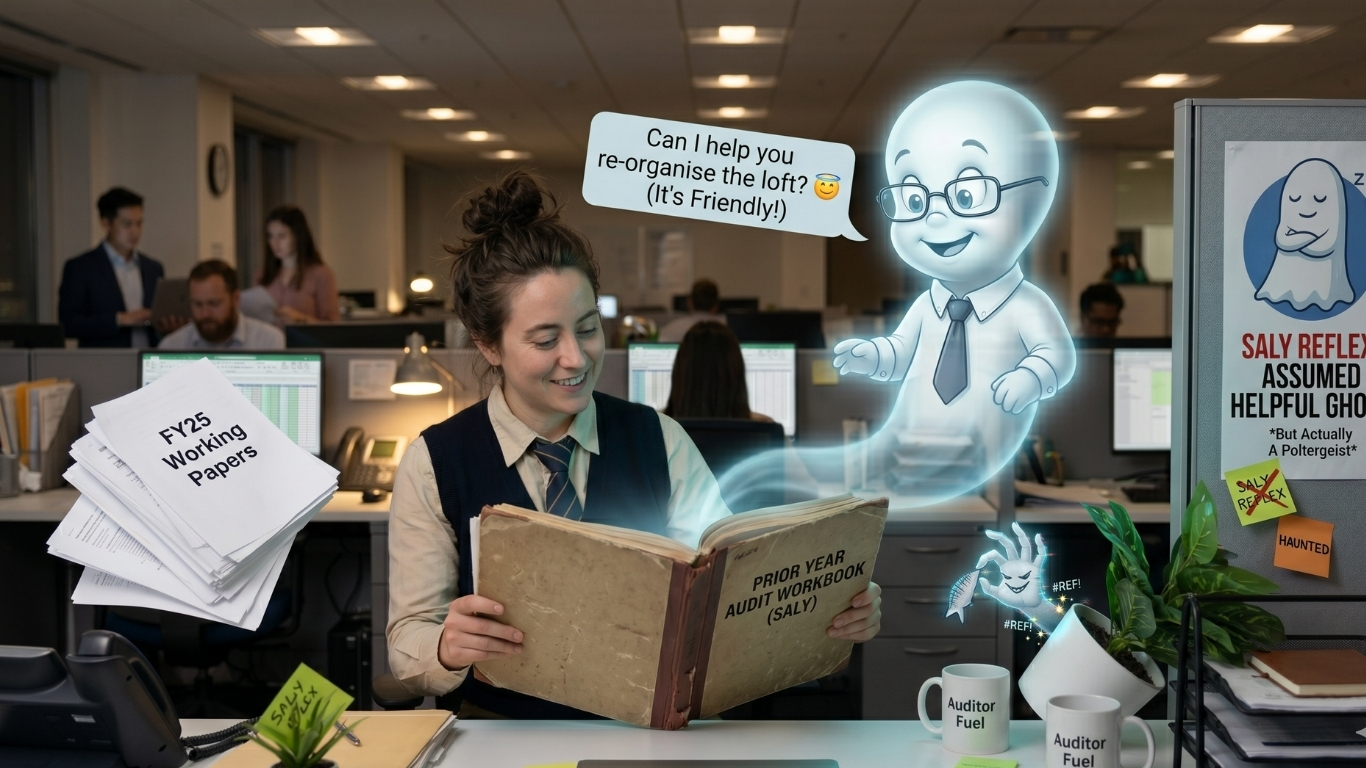
Within a week, your reputation is sealed. You become the unofficial IT support for Microsoft products. Every haunted 40-tab workbook from 2018, every unformatted export that looks like it was typed by a cat walking across a keyboard, quietly finds its way to your inbox.
It is incredibly easy to joke that people are just offloading their chaos onto you. But the truth is much softer, and a lot more human. They aren't throwing their problems at you; they are handing you the wheel because they trust you. You have accidentally become the team's safety net.
And if we are being completely honest? We usually hold onto that role willingly.
As we have explored throughout June, we have a strange, deep-rooted psychological attachment to the grind. Just like the "Bad Book Hostage" who refuses to put down a terrible novel because they've already invested the time, we tie our professional identity to our ability to endure friction. When you become the resident "Excel Wizard," you keep swinging the blunt axe for everyone else because you know you are strong enough to carry the weight. Rescuing the impossible makes you feel indispensable.
But relying on a human safety net to fix broken data isn't a sustainable methodology. It’s just a comforting habit.
The strongest professionals eventually realise that their true value isn't in acting as a human macro for the rest of the office. Your value lies in your judgement, your professional scepticism, and your ability to see the bigger picture.
When you let go of the need to personally wrestle every spreadsheet into submission, you make room for better infrastructure. You stop rescuing broken sheets and start relying on tools that structure the data natively from the moment it arrives.
It is time to hang up the cape. You don't need to be the hero when the foundation itself is solid.
Until next week,
Christiaan
P.S. If your firm relies on a few "Excel wizards" to survive the week, it’s time to upgrade your systems. Watch how we replace the manual grind with a native framework so your whole team can excel right here.
.png)








































































.png)
.png)
.png)


.png)
.png)
.png)







Help your team work faster in Microsoft Excel without
sacrificing control, traceability, or audit quality.
Inspiration not perspiration with tips and insights to audit smarter, straight to your inbox.
You can unsubscribe at any time. We respect your information and won’t share your data with any 3rd parties. Learn more about our privacy policy.

.svg)

.png)
