

Before May 6, 1954, the four-minute mile was considered physically impossible.
Many experts believed the human body simply couldn't handle the sheer mechanics of that speed. It wasn't just a goal; it was considered a hard, biological limit of the human species.
Then, a medical student named Roger Bannister stepped onto a muddy track in Oxford. He didn't have modern running shoes, and he certainly didn't have a multimillion-dollar training facility. But he ran it in 3:59.4.
The most fascinating part of this story isn't the broken record. It’s the aftermath. Just 46 days later, someone else broke it. Then a few more. Today, college athletes routinely run sub-four-minute miles in weekend tournaments.
The barrier was never physical. It was entirely psychological. Once people saw that it could be done, the "impossible" simply became the new baseline.
We have to confront the audit industry’s version of the four-minute mile. For decades, we have accepted a massive psychological barrier regarding how work gets done.
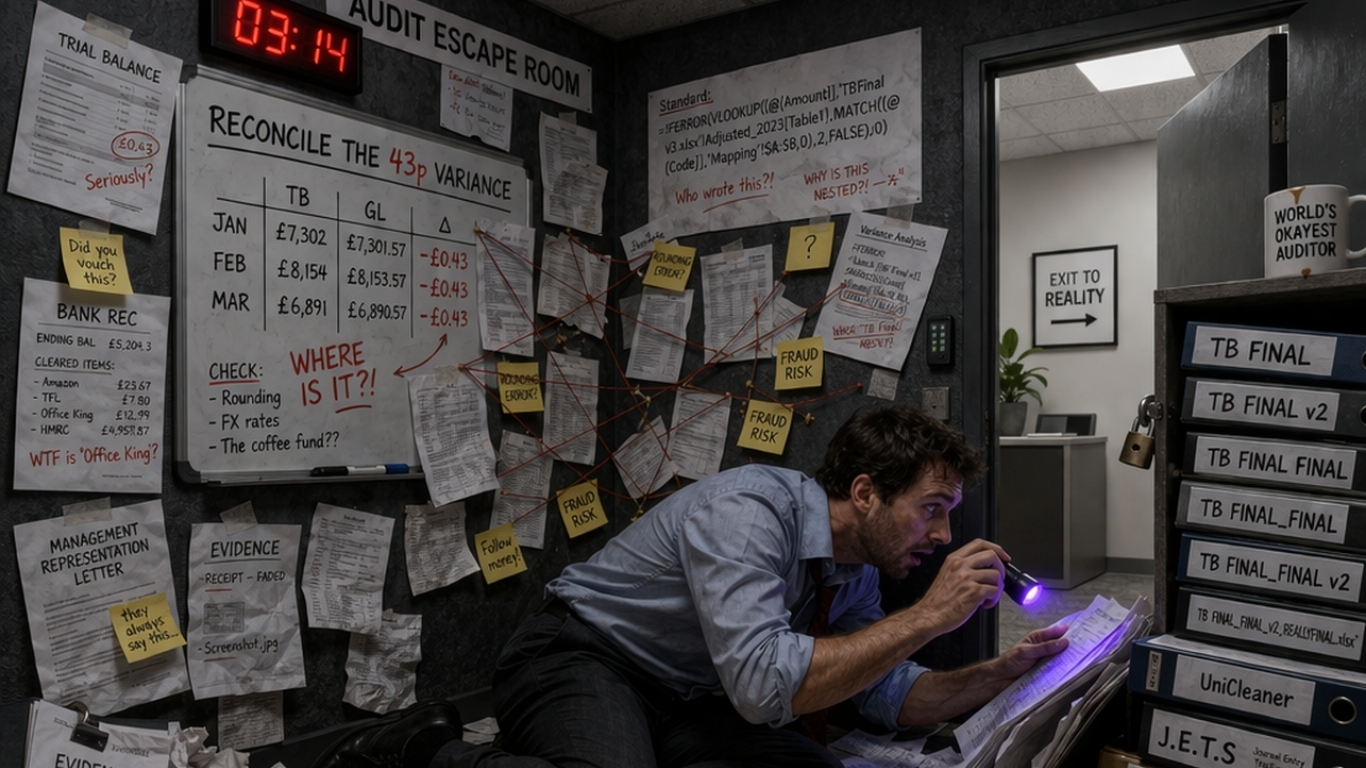
We treat RAM shortages, endless paging delays, and the spinning wheel of death as a natural consequence of a "thorough" audit. When a 50-tab workbook takes four minutes just to calculate a formula, we don't question the workbook. We just assume the data is too heavy.
We have convinced ourselves that this friction, the constant crashing, the manual rebuilding, the endless waiting is somehow a regulatory requirement. We believe the struggle proves we are working hard.
But what if it is simply a failure of architecture? What if, like the 1950s medical experts, we are defending a limit that doesn't actually exist?
Your "four-minute mile" is the exact moment that illusion shatters. It is the moment you realise that escaping this grind isn't about a stronger work ethic. It is about mastering the design.
When you witness a complex sampling workflow that used to lock up your machine suddenly execute in seconds, everything changes. The impossible becomes standard. When architecture imposes order natively, you stop fighting the tools.
Mastery is not about learning to survive the friction. It is about designing a workflow where the friction no longer exists.
It is time to stop accepting the lag. Stop merely surviving the mess, and start mastering the design.
Until next time,
Christiaan
.png)







































































.png)
.png)
.png)


.png)
.png)
.png)







Help your team work faster in Microsoft Excel without
sacrificing control, traceability, or audit quality.
Inspiration not perspiration with tips and insights to audit smarter, straight to your inbox.
You can unsubscribe at any time. We respect your information and won’t share your data with any 3rd parties. Learn more about our privacy policy.

.svg)

.png)
