

In 1887, a young Chicago machinist named Dorr E. Felt patented a device that was supposed to change the accounting world forever: the Comptometer.
It was the first commercially successful key-driven mechanical calculator. For late 19th-century clerks, it felt like pure witchcraft. Instead of manually tallying endless columns of numbers by hand, you simply pressed a series of spring-loaded keys, and internal mechanisms did the heavy arithmetic for you.
There was just one glaring problem: the gears.
When pushed to the absolute limit during heavy reporting periods, the Comptometer had an infuriating habit of jamming. If an anxious clerk struck the keys a fraction too fast, or failed to depress a key with the exact required pressure during rapid calculations, the internal carrying levers would misfire and lock up. The machine would freeze.
Instead of actually calculating, entire accounting departments would grind to a halt. Highly skilled professionals had to put down their ledgers, grab tiny metal screwdrivers, and spend hours performing emergency mechanical maintenance on jammed gears just to get the mechanism turning again.
We look back at those 1887 clerks tinkering with stuck metal levers and shake our heads at the absurdity of it.
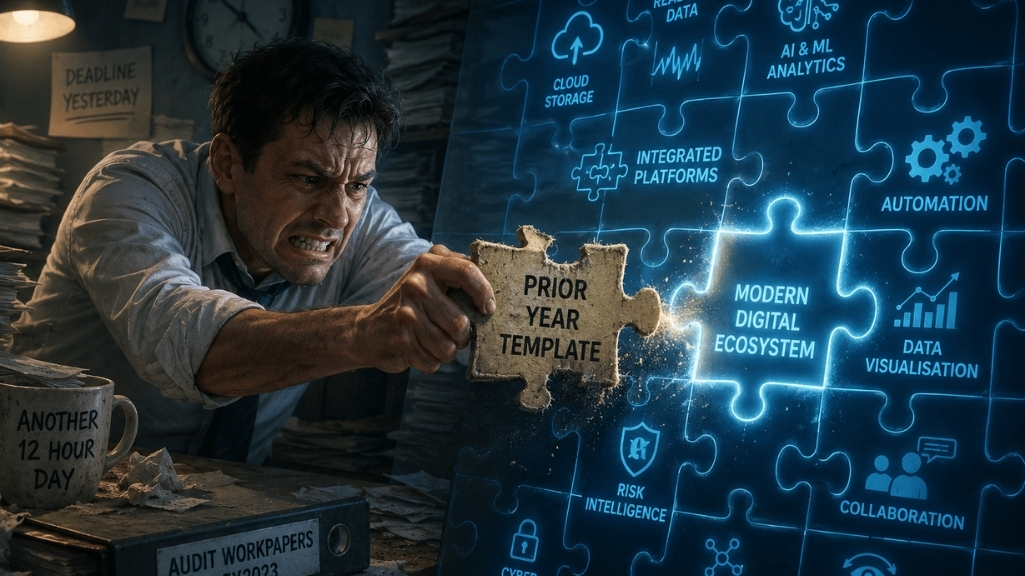
Yet, over a century later, as we look at our own modern workflows, it begs a fundamental question: when the technology to eliminate manual friction completely already exists, is our reliance on tedious, legacy processes a reflection of the tools we lack, or simply an unwillingness to step into the next era of our own profession?
The auditing profession has undergone a staggering evolution. We have graduated from bound paper ledgers to early digital grids, and now to automated data pipelines and intelligent reporting systems. As an industry, we have come much too far to spend our working hours acting as manual data mechanics.
The challenge today is no longer a lack of computational power or access to better solutions. The tools required to handle industrial, enterprise-level client data natively are already sitting right in front of us.
When we force modern, complex data demands into outdated, general-purpose workflows, we are artificially capping our own potential. But when we shift our mindset toward actually leveraging the structured reporting frameworks and enterprise-grade infrastructure available to us today, the entire paradigm changes.
The manual friction disappears. The processes flow natively. We stop spending our time manipulating the medium and return our focus to the high-level, analytical evaluation we were actually trained to perform.
Escaping the historical loop is about recognising our own progress. The technology has already evolved; it is simply time we align our daily workflows with how far the profession has come.
Until next week,
Christiaan
.png)





































































.png)
.png)
.png)


.png)
.png)
.png)







Help your team work faster in Microsoft Excel without
sacrificing control, traceability, or audit quality.
Inspiration not perspiration with tips and insights to audit smarter, straight to your inbox.
You can unsubscribe at any time. We respect your information and won’t share your data with any 3rd parties. Learn more about our privacy policy.

.svg)

.png)
