Every population has a few large items that nobody wants to leave to chance.
Every audit team has its own way of dealing with them. Some also have a tab called “Strat v3 FINAL (2)”, but that is a story for another Friday.
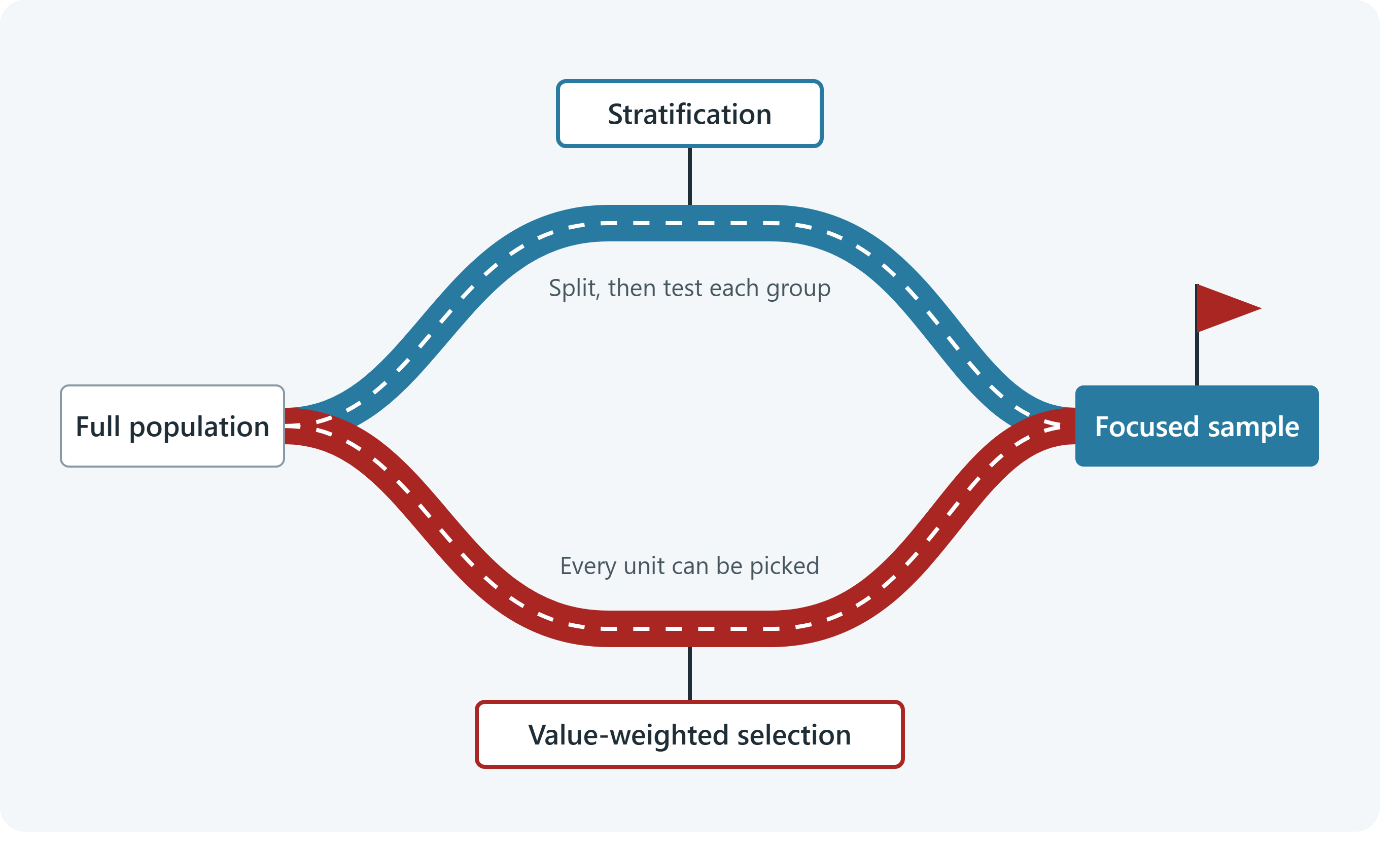
Whichever route you take, the goal is the same: a smaller, more focused sample, with sampling risk kept at an acceptable level.
Stratification splits the population into groups that share a characteristic, such as key items versus the rest, or debits versus credits, and tests each group on its own. Items within a group are more alike, so you can sample fewer of them without taking on more risk.
Value-weighted selection doesn’t split anything. Every individual monetary unit in the population is a candidate for selection, so bigger items are simply more likely to be picked.
These aren't competing options. Either can be used on its own, and auditors often combine them: first separating out the items that need different treatment, then using value-weighted selection on the rest.
Monetary Unit Sampling (MUS) is the second of these, and it is what the Sampling Tool in the Audit Toolbar does. You set the interval, or give a target sample size and let the tool work it out. Items at or above your materiality threshold are treated as key items: tested in full and tagged separately, with the rest of the population sampled by value. The output records the parameters, the population and sample values, and the coverage, and everything runs locally in Excel, so client data stays where it is.
Nicolene Ras, Audit Senior at Ecovis ARB, said of the MUS function:
“The MUS Sampling tool in the Audit Toolbar has made sampling faster, removes human error in the sampling process and it ensures that a sample can be reperformed with the seed value.”
As ever, you decide the population, the interval or sample size, and how the results are evaluated. The tool simply makes the selection easier to document and repeat.
Managers are planning year-end audits now, and it is easier to choose your approach in the plan than in the middle of busy season.
Next week, we look at the question every reviewer eventually asks: how was this sample selected?
Until next time,
Christiaan
Let Value Do the Weighting
The Audit Toolbar’s Sampling Tool includes a Monetary Unit Sampling (MUS) function that:
You stay in control of the population, the interval or sample size, and the evaluation of results.
See the Sampling Tool run on a population like yours. Book a demo














































































Help your team work faster in Microsoft Excel without
sacrificing control, traceability, or audit quality.
Inspiration not perspiration with tips and insights to audit smarter, straight to your inbox.
You can unsubscribe at any time. We respect your information and won’t share your data with any 3rd parties. Learn more about our privacy policy.